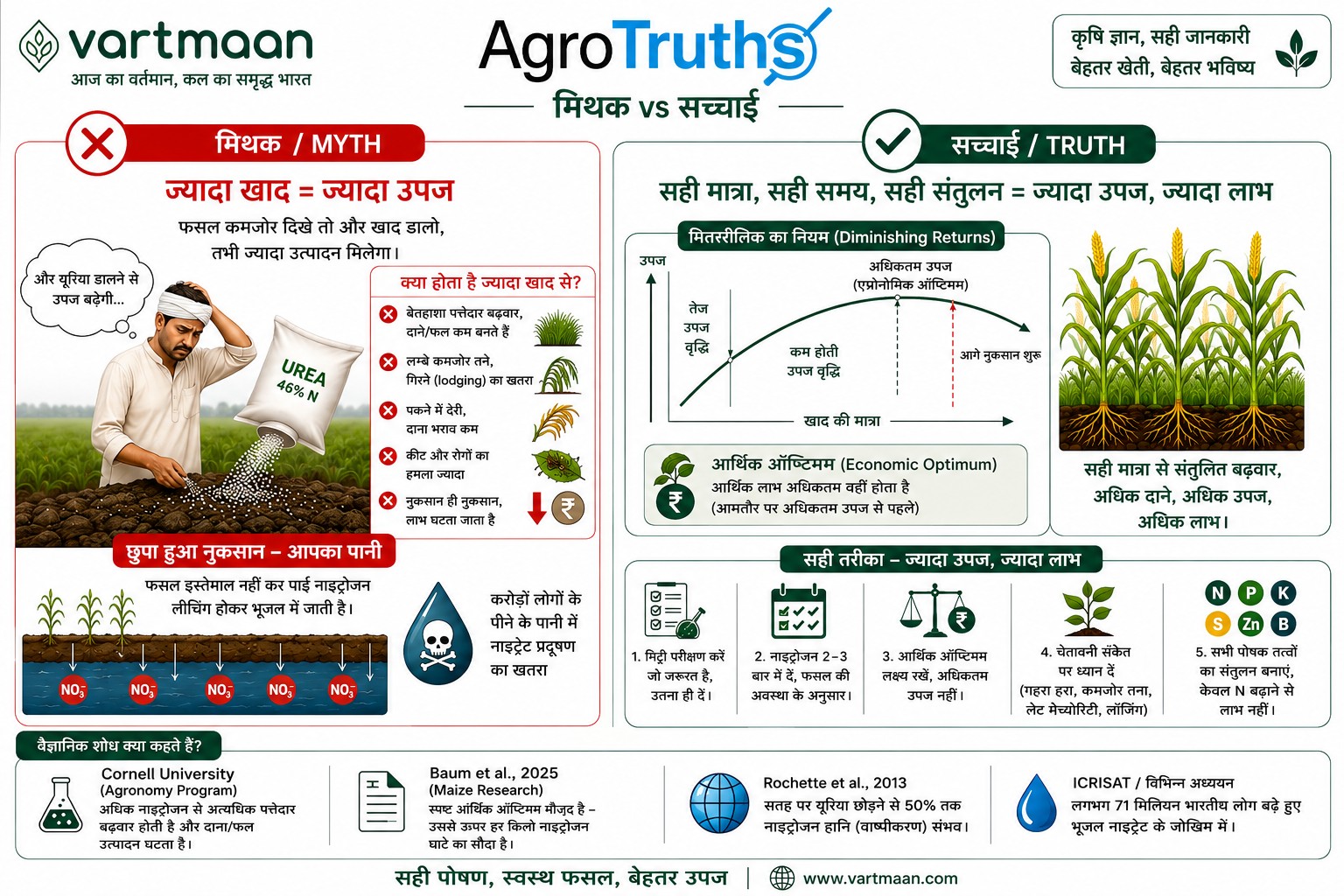
The Truth:
Crop yield follows the Law of Diminishing Returns — each extra kg of fertilizer adds less yield than the last, until yield plateaus and then declines. Excess nitrogen causes lodging, delayed maturity, poor grain filling, and pest/disease pressure, cutting both yield and quality.
Explanation
Crop yield doesn't rise in a straight line with fertilizer. The first doses give a big jump because the crop is starved, but each additional dose adds less than the one before — until yield hits a plateau (the agronomic optimum) and then starts to fall. Push past that point and the plant pours energy into dark, floppy leaves instead of grain: stalks grow tall and weak and lodge (bend and break), maturity is delayed, and grain filling suffers. Excess nitrogen the crop can't use leaches below the roots as nitrate, polluting groundwater — a cost you pay twice. The profitable target is the economic optimum, which usually sits slightly below the yield-maximizing rate. The smart fix: soil-test first, split your nitrogen across growth stages, and keep nutrients balanced instead of just adding more.
In-Depth Analysis
Evidence Strength
Sources & References
- Mitscherlich Law of Diminishing Returns
- Cornell University CSS412 Nitrogen Management
- Baum et al. 2025 Nature Communications
- Craswell 2021 SN Applied Sciences
- Sarkar et al. 2021 Journal of Contaminant Hydrology
Tags:
Related Vartmaan Products
Reviewed by:Devashish Gupta
Last reviewed: 2026-08-10
Was this information helpful?
2 people found this helpful